
The music is already playing when the older brother approaches the house. He calls a servant over, learns that his younger brother is back and that their father has killed the fattened calf, and he refuses to go in (Luke 15:25–28).
We often remember the parable of the prodigal son for the son who ran away. Jesus ends it with the son who never left, standing outside a party his father wants him to join. If you’ve tried to be faithful for years, he may be the character who looks most like you.
The older brother shows how obedience can become a claim on God’s favour, and how that claim can make another person’s welcome feel unfair. His father invites him to share the joy of someone lost being found.
Why Jesus tells this story
The parable begins before either son appears. Tax collectors and sinners are coming to hear Jesus, and the Pharisees and scribes are grumbling: “This man welcomes sinners and eats with them” (Luke 15:2, BSB).
Jesus replies with three stories of something lost and found: a sheep, a coin and a son. Each time, finding leads to a celebration. When the younger son returns, having decided to confess his sin, his father runs to him, kisses him and calls for a feast.
Then the pattern breaks. This time somebody refuses to celebrate. The older son’s complaint echoes the objection Jesus’ listeners made at the beginning. Nobody pretends the younger son’s choices were good. The argument is about whether his return is reason to celebrate.
Why was the older brother angry?
When his father comes out, the older son more or less hands him a receipt. Notice that he doesn’t begin with “Father.” He begins with “Look”:
“Look, all these years I have served you and never disobeyed a commandment of yours. Yet you never gave me even a young goat so I could celebrate with my friends.”
— Luke 15:29, Berean Standard Bible
His brother’s speech began with Father. He leaves it out. A moment later he calls the returning man “this son of yours” (Luke 15:30, BSB). He won’t call him his brother. And he sets a young goat he never got against the fattened calf prepared for the celebration.
He claims he has never once disobeyed. We don’t have to take his word for it to see what he thinks it should have bought him.
It doesn’t take anything dramatic for us to start thinking that way. Imagine washing up after a family meal. The work is fine, and asking for help is fine. The trouble begins when you’re also keeping a private ledger of who thanked you and who sat down first, until the laughter from the next room feels like an insult.
Prayer can pick up the same habit. I’ve been faithful. I’ve tried to obey. Why did they get what I’ve been praying for? At that point we may be turning a desire brought to God into a bill we expect Him to pay.

Disappointment and contempt
Being tired or disappointed is not the older brother’s sin. Neither is grief, asking God why a prayer still hasn’t been answered, or pointing out that the dishes really should be shared. The Psalms make room for honest complaints brought to God; Psalm 13 is an example.
Jesus names the real danger in another parable, told to some “who trusted in their own righteousness and viewed others with contempt” (Luke 18:9, BSB). A Pharisee lists his fasting and tithing and thanks God he isn’t like other people. A tax collector stands at a distance and begs for mercy. It’s the tax collector, Jesus says, who goes home justified, put right with God (Luke 18:9–14).
That’s the combination to watch for: my record makes me deserving and your failure puts you beneath me. One revealing question is what happens inside you when someone else is shown mercy. If their welcome makes your own faithfulness feel wasted, you’re standing roughly where the older brother stood.
The father comes outside
The father could have left him there. Instead, he goes out and pleads with him (Luke 15:28).
“‘Son, you are always with me,’ the father said, ‘and all that is mine is yours. But it was fitting to celebrate and be glad, because this brother of yours was dead and is alive again; he was lost and is found.’”
— Luke 15:31–32, BSB
His son has been talking as though his service should secure a reward. The father answers with belonging: you are always with me, and everything I have is yours. Then he restores the relationship in his wording. “This son of yours” becomes “this brother of yours.” He doesn’t call the younger son’s wrongdoing harmless. He says the one who was lost is back, and that is reason to celebrate.
And Jesus stops there. We never learn if the older brother goes in. The open ending leaves the listeners who objected to Jesus’ welcome with their own response to make. It leaves us with a question too.
Grace comes first
If good behaviour doesn’t buy God’s favour, why bother being good? Ephesians 2:8–10 holds grace and good works together. We are saved by grace through faith, as God’s gift, so no one can boast. And we are His workmanship, created in Christ Jesus for good works.
God doesn’t wait for good works to make us worth saving. He saves us, and good works belong to the new life He gives. Titus 3:3–8 follows the same order: the envy we once lived in, God’s mercy, the Spirit’s renewing work, and then a call to devote ourselves to doing good.
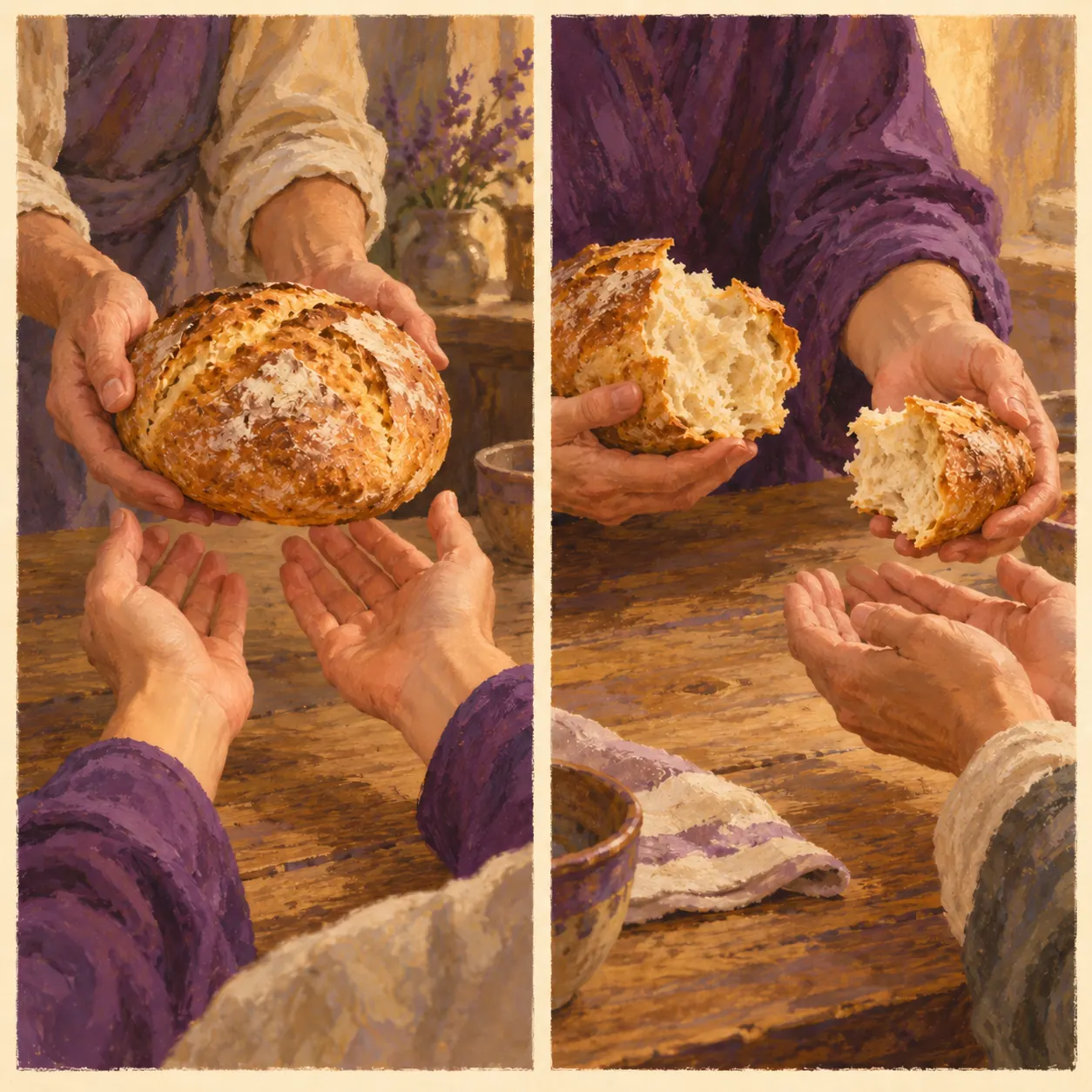
Remembering the mercy we’ve received gives us a reason to put down the ledger. We can still wash the plates and ask for help. The evening doesn’t have to prove what we’ve earned with God.
Dropping the scorecard
Start by naming the thought plainly. “After everything I’ve done, God owes me this.” Or, “They shouldn’t be welcomed until they’ve proved they’re as serious as I am.” A specific sentence is easier to confess than a vague resolution to be humbler.
Bring it to God with the desire underneath it. You can ask for what you want without pretending you’ve paid for it. If you’ve looked down on someone, ask forgiveness for that too.
Then do one small thing that fits the situation. Thank God for the return of someone you’d privately written off. Welcome them into a conversation. Do a needed kindness without saving it as evidence against them later. These are ways to respond to mercy, not a new test you must pass to earn it.
If words are hard to find, you could pray:
“Father, I’ve been counting what I’ve done and resenting the kindness You’ve shown someone else. Forgive me. Help me receive Your mercy through Jesus and seek my neighbour’s good. Teach me to share Your joy.”
The story ends with the father still outside, still talking to his son. If you recognise yourself there, listen to the invitation. You don’t have to keep arguing your case at the door.
Reading and inspiration
Read Luke 15, Luke 18:9–14, Psalm 13, Ephesians 2:1–10 and Titus 3:3–8 in context. Scripture quotations are from the Berean Standard Bible (BSB), a public-domain translation.
This original reflection was prompted in part by Tim Keller’s sermon “The Prodigal Sons”, preached at Redeemer Presbyterian Church on September 11, 2005. Its argument and applications have been developed from the biblical passages above.
The illustrations were created with AI. The opening scene is an artistic interpretation of Jesus’ parable; the kitchen and bread images are everyday illustrations.
For help putting an honest prayer into words, read How to Pray When You Don’t Know What to Say.