
Almost everyone asks it eventually: if God is all-powerful and all-good, why do bad things happen to good people?
The Bible asks it too. “Why standest thou afar off, O LORD? why hidest thou thyself in times of trouble?” is how Psalm 10 begins. Job, Lamentations and a good share of the Psalms are people asking God some version of “why?” out loud. So the question is fair.
Scripture answers part of it. It says where suffering comes from: a world damaged by sin, where people can hurt each other. It does not tell us why a particular tragedy falls on us or on someone we love. What it offers there is God Himself, present in the pain and able to bring good out of evil.
But it’s worth looking at the question itself first, because it carries an assumption.
Who counts as “good”?
When a man ran up to Jesus and called Him “Good Master,” Jesus stopped him on that one word:
“Why callest thou me good? there is none good but one, that is, God.” — Mark 10:18
Paul puts it even more plainly: “For all have sinned, and come short of the glory of God” (Romans 3:23).
That doesn’t mean the people we love aren’t kind, generous or brave. They are. It means “good people” is a relative category. Measured against God, only one person has ever lived without sin, and He went to the cross willingly. The rest of us all fall short, and that explains nobody’s pain in particular.
So the real question is less “why do bad things happen to good people?” and more “why is the world broken, and what is God doing about it?”
We live downstream of Eden
Scripture’s starting answer is sin. God made a world He called “very good” (Genesis 1:31). Humanity chose disobedience, and the damage didn’t stay with Adam and Eve:
“Wherefore, as by one man sin entered into the world, and death by sin; and so death passed upon all men, for that all have sinned:” — Romans 5:12
In Genesis 3 the ground itself is cursed. Later, Paul writes that creation is still feeling it: “the whole creation groaneth and travaileth in pain together until now” (Romans 8:22).
Think of it as collateral damage. The tumour, the earthquake, the baby born with a heart defect: none of these is automatically somebody’s punishment. They’re what a fractured world does. All of us live downstream of that first decision.

Three ways the damage reaches us
It helps to pull apart a few things that often get blurred together.
1. Sometimes it’s the harvest of our own choices
This is the uncomfortable one. “Be not deceived; God is not mocked: for whatsoever a man soweth, that shall he also reap” (Galatians 6:7).
When we come to God honestly, He forgives completely (1 John 1:9). But forgiveness isn’t the same as erasing consequences. A person can be fully forgiven and still be paying off the debt, rebuilding the trust, or walking out of years of addiction one day at a time. David was forgiven after Bathsheba, and the fallout still tore through his household (2 Samuel 12).
So sometimes, when we ask God why something is happening, part of the answer is in the mirror. That isn’t a reason for shame. It’s where repentance and repair begin.
But be slow with this one, especially when it’s about someone else. When the disciples saw a man born blind, they assumed somebody must be to blame. Jesus said:
“Neither hath this man sinned, nor his parents: but that the works of God should be made manifest in him.” — John 9:3
Job’s friends spent most of a book insisting his suffering proved he’d sinned, and God told them they had not spoken of Him rightly (Job 42:7). Pain is not proof of guilt.
2. Sometimes it’s someone else’s sin against us
A lot of suffering has nothing to do with the person carrying it. The child who was abused. The husband or wife who was betrayed. The family hit by a drunk driver on the way home. They didn’t cause it. They were on the receiving end of someone else’s choices.
People make real choices, and real choices have real reach. The cruelty belongs to the one who chose it. If you’re carrying a wound somebody else gave you, hear this plainly: it was not your fault.
3. Sometimes there’s an enemy in it
The Bible doesn’t treat evil as only a human problem. Peter warns that our adversary “walketh about, seeking whom he may devour” (1 Peter 5:8), and the book of Job opens with Satan setting out to ruin an upright man.
Not every hard day is spiritual warfare, and blaming the devil can become a way to dodge responsibility. Peter doesn’t ask his readers to work out which is which. He tells them to “resist stedfast in the faith,” and reminds them that “the same afflictions are accomplished in your brethren that are in the world” (1 Peter 5:9). Whatever the source, they are not the only ones going through it.
Nothing reaches us without passing through His hands
Here’s where the hope comes in. None of this means God has lost control of His world.
In the first chapter of Job, Satan can touch Job only within the limit God sets: “only upon himself put not forth thine hand” (Job 1:12).
Notice what Job is never given. He doesn’t hear about the conversation in heaven. When God finally answers him, near the end of the book, He still doesn’t say why (Job 38). So the book gives none of us licence to tell a grieving person what their pain was for.
Jesus tells His disciples that even a sparrow, sold two for a farthing, is not beyond God’s notice: “one of them shall not fall on the ground without your Father” (Matthew 10:29). The sparrow still falls, but not outside the Father’s knowledge or care.
Paul wrote one of the most quoted verses in the Bible straight after a passage about groaning. Creation groans, we groan, and the Spirit prays for us “with groanings which cannot be uttered” (Romans 8:22–26):
“And we know that all things work together for good to them that love God, to them who are the called according to his purpose.” — Romans 8:28
People often stop reading there, as if “good” meant “comfortable.” The next verse says what God is aiming at: that we would be “conformed to the image of his Son” (Romans 8:29). The good God is working toward is that we become like Jesus. He doesn’t waste our pain.
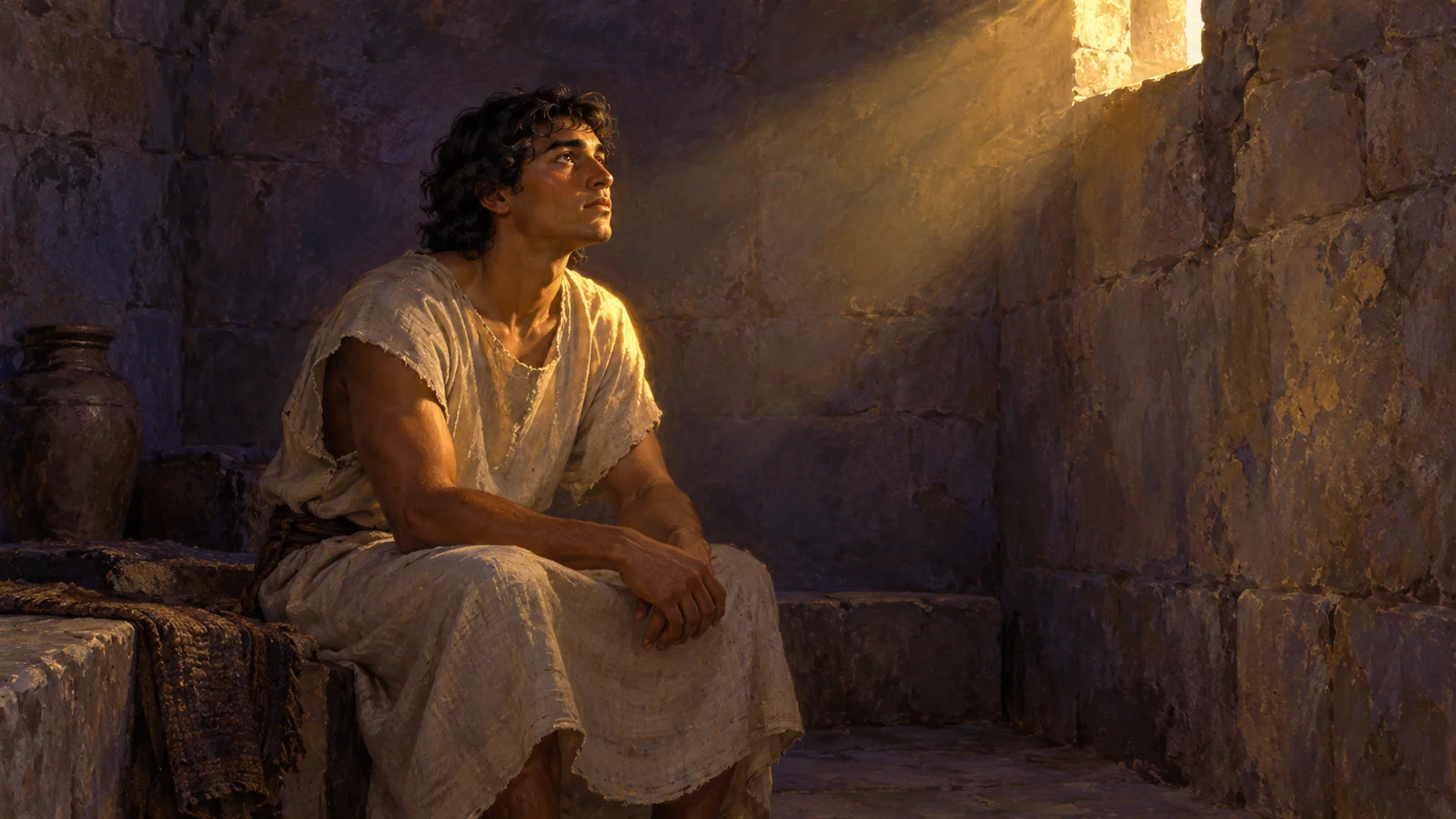
Joseph’s life shows what that can look like. Sold into slavery by his own brothers (Genesis 37). Falsely accused by his master’s wife and thrown into prison (Genesis 39). Forgotten for two more years by the very man he’d helped (Genesis 40:23; 41:1). By any ordinary measure, his life was ruined.
Then, decades later, the brothers who sold him stand terrified in front of him, and he says:
“But as for you, ye thought evil against me; but God meant it unto good, to bring to pass, as it is this day, to save much people alive.” — Genesis 50:20
Joseph never pretended it wasn’t evil. Ye thought evil against me. He simply saw that the same events had carried two intentions, theirs and God’s, and God’s was the one that stood.
When the thorn stays
Does all this mean God takes the pain away if we pray hard enough? Honestly, no. Sometimes He heals. Sometimes He gives peace instead of an explanation. And sometimes the healing waits for heaven.
Paul begged God three times to remove what he called a thorn in his flesh. God’s answer was, “My grace is sufficient for thee: for my strength is made perfect in weakness” (2 Corinthians 12:9). The thorn stayed. So did the grace.
Psalm 23 doesn’t promise there will be no dark valley. It promises company in it:
“Yea, though I walk through the valley of the shadow of death, I will fear no evil: for thou art with me; thy rod and thy staff they comfort me.” — Psalm 23:4
On this side of heaven, some pain stays. But the cross shows how far God was willing to come into our suffering, and the empty tomb shows that suffering won’t have the last word. One day, “God shall wipe away all tears from their eyes; and there shall be no more death, neither sorrow, nor crying, neither shall there be any more pain” (Revelation 21:4).
Sin explains why the world is broken. The cross explains why it won’t stay that way.

Scripture quotations are from the King James Version (KJV). Passage links open Faith In Purple’s Berean Standard Bible reader, whose wording differs from the KJV.